agent-audit
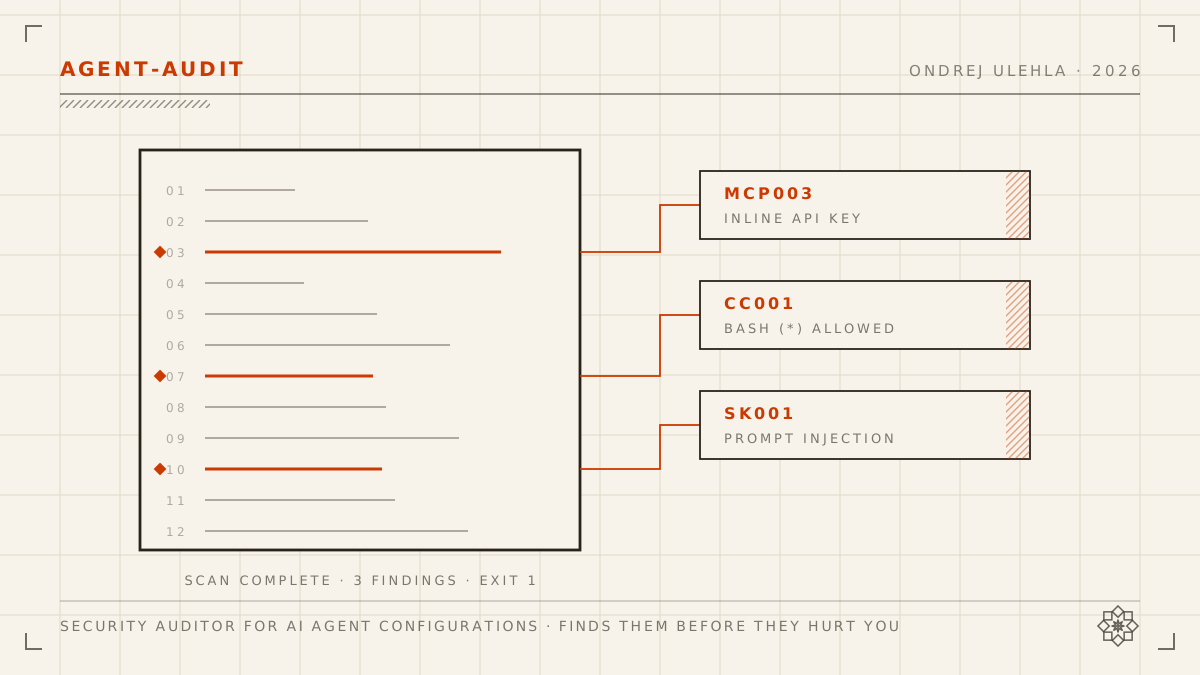
An open-source security auditor for AI agent configurations – finds inline secrets, unpinned supply chains, blanket permissions and prompt-injection surfaces before they hurt you.
- Role
- Author & Maintainer
- Year
- 2026
Problem
AI agents brought a new attack surface – MCP servers, permissions, skills and hooks – that classic linters and secret scanners simply do not see.
Solution
A zero-dependency CLI with a rules engine that scans agent configs for ten classes of risk, with redacted output, line numbers and CI-ready exit codes.
Outcome
One command (npx agent-audit) turns an invisible attack surface into an actionable report – locally and as a CI gate.
Context
Agentic tooling exploded in 2025–2026: MCP servers, Claude Code settings, skills from
marketplaces, hooks that run unattended. Each of those is configuration that acts –
it executes commands, reaches the network, reads your filesystem. Yet the security
tooling around it lagged behind: eslint doesn’t know what Bash(*) means, and secret
scanners don’t understand that an unpinned npx some-mcp is a supply-chain time bomb.
Problem
Four classes of risk kept showing up in real-world agent setups:
- Supply chain – MCP servers launched via
npx/uvxwithout a pinned version: every session runs whatever was published last - Blast radius –
Bash(*)permissions orbypassPermissions, turning any successful prompt injection into arbitrary code execution with no human in the loop - Secrets – API keys committed inline in
.mcp.json, readable by every agent and every collaborator - Instructions as code – third-party skills and agents carrying injection payloads (“ignore previous instructions…”, remote instruction fetches, hidden base64)
Solution
A zero-runtime-dependency TypeScript CLI built around a small rules engine:
- Discovery walks the repo and classifies config files across dialects
(
.mcp.json, Claude Desktop, VS Code,.claude/settings, agents, skills, hooks) - Normalisation maps the different MCP config shapes onto one server model
- Ten rules check transport security, version pinning, filesystem scope, permission wildcards, exfiltrating hooks, tool-combination risks and injection markers
- Reporting prints findings with severity, line numbers and redacted secrets;
--jsonfor machines, exit codes for CI (--fail-on warning)
The whole tool is designed to be run as npx agent-audit – no install, no config,
useful output in seconds.
Outcome
- Ten risk classes covered by deterministic rules – no API keys or LLM calls needed
- Redaction built in: the report never re-leaks the secret it just found
- Drops into any pipeline as a one-line CI gate
- Open source (MIT) with a roadmap: SARIF output, more dialects, allowlists, autofix
What I learned
Security tooling lives or dies by its false-positive rate – every rule needed an explicit notion of what a reference (safe) versus a literal (risky) value looks like before the reports became trustworthy enough to gate CI on.